
ePaper Displays
Optimizing Power Budgets for Outdoor e-Paper Deployments
Learn engineering strategies to minimize power consumption in outdoor EPD systems, focusing on waveform management, temperature compensation, and update algorithms.
Download WhitepaperPower consumption for bistable e-ink display modules is lower than any other display technology, as the image requires refreshing only when content changes. These embedded e-paper display modules are ideal for applications where power is severely constrained. Once the image is shown on the display, it will remain visible using zero power. The high contrast ratio and anti-glare surface make an e-ink display module easy to read in bright sunlight.
Currently, we have sizes ranging from 200x200 resolution with a 1.54" diagonal active area to 640x384 resolution with a 7.5" active area. We have e-ink and e-paper display modules in black & white and monochrome. We even offer a flexible E Ink display!
For a fast start, use our sample code to display your images. Our open-source e-paper demonstration code runs directly on a low-cost Seeeduino v4.2 or Arduino running 3.3v. Browse our complete line of ePaper Development Kits for a head-start in developing with e-ink technology.

Diagonal Dimension: N/A
Interface(s): SPI
Price Range: $9.42 - $11.68
Details for ePaper Adapter Board
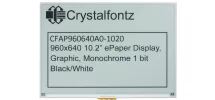
Diagonal Dimension: 10.2
Interface(s): SPI
Colors: Black on White
Resolution: 960x640 pixels
Price Range: $113.40 - $130.81
Details for 10.2-Inch ePaper Display Module, 960x640 Black and White

Diagonal Dimension: 2.87
Interface(s): SPI
Colors: Black on White
Brightness Rating: Sunlight
Resolution: 128x296 pixels
Price Range: $12.55 - $17.80
Details for 2.9 Inch ePaper Display

Diagonal Dimension: 5.83
Interface(s): SPI
Colors: Black on White
Resolution: 600x448 pixels
Price Range: $58.70 - $67.72
Details for 5.83 inch ePaper display

Diagonal Dimension: 1.53
Interface(s): SPI
Colors: Black on White
Resolution: 152x152 pixels
Price: $5.00
Details for 1.54" 152x152 Square ePaper Display

Diagonal Dimension: 2.13
Interface(s): SPI
Colors: Black on White
Brightness Rating: Sunlight
Resolution: 122x250 pixels
Price Range: $8.13 - $9.33
Details for 122x250 2.13" ePaper Display Module

Diagonal Dimension: 1.5
Interface(s): SPI
Colors: black on white
Brightness Rating: Sunlight
Resolution: 200x200 pixels
Price Range: $7.27 - $8.38
Details for 1.54" 200x200 Square ePaper Display

Diagonal Dimension: 7.49
Interface(s): SPI
Colors: Black on White
Resolution: 640x384 pixels
Price Range: $58.67 - $77.33
Details for 7.5" Black & White ePaper Display Module

Diagonal Dimension: 4.2
Interface(s): SPI
Colors: Black on White
Brightness Rating: Sunlight
Resolution: 400x300 pixels
Price Range: $23.72 - $27.37
Details for 4.2" Black and White ePaper

Diagonal Dimension: 7.5
Interface(s): SPI
Colors: Grayscale on White
Resolution: 800x480 pixels
Price Range: $41.80 - $49.00
Details for 800x480 7.5" ePaper Display Module
Frequently Asked Questions
Why do electronic shelf labels use ePaper rather than LCD?
Because a shelf label changes a few times a day and then has to sit there. ePaper draws power only during an update, so a label can run for years on a coin cell, where an LCD would need its backlight or at least its drive electronics powered continuously. ePaper is also readable from any angle under store lighting and looks like a printed tag.
The trade-offs that matter in that application are update speed, a limited colour palette, and behaviour at low temperature, which is why chilled and frozen aisles need parts rated for it.
For a small battery-powered device, should I use OLED, TFT LCD or ePaper?
Start with how often the screen changes.
ePaper holds an image with no power at all and only draws current when it updates. If the display shows a reading that changes every few seconds or less often, ePaper beats everything else on battery life by a wide margin, and it is the most readable of the three in sunlight. It cannot do video, updates take a noticeable fraction of a second, and color options are limited and slower still.
OLED / PMOLED is self-emissive, so its power depends on how many pixels are lit and how brightly. For sparse content on a black background it is very efficient. For a mostly-white screen it is not. It gives excellent contrast and a wide viewing angle and needs no backlight; its weaknesses are limited lifetime at high brightness and image retention with static content.
TFT LCD is the answer when you need full color, a real interface or moving content. Power is dominated by the backlight, which is on whenever the display is on regardless of what is shown. A transflective TFT recovers much of the outdoor readability and some of the power.
A useful test: if the device spends most of its time showing the same thing, use ePaper. If it shows a little bright information on a dark screen, use OLED. If it shows a colour interface, use a TFT.

LCD Software
Download LCD Drivers & utilities for our hardware.

User Forum
Get information and support from our user community.

Tech Support
Contact us for free product technical support